The world-renowned mandolinist, who now heads the conservatory in the Eshkol Regional Council, talks about the unique Be’er Sheva school, his unusual participation in the ARTE competition, the quirks of his instrument, and even a touch of mystical experience
Roi Dayan is young, strikingly charismatic, and unquestionably one of the most dazzling mandolinists of his generation. He is clearly in love with his instrument, playing it with a passion that would surely have earned the approval of Captain Corelli himself. His mandolin can be delicate and capricious like a Watteau painting, or structured and geometrically precise like a Braque. As for his incredible technique and inventiveness, words alone cannot convey it—you just have to hear it. Roi Dayan will perform with the Israel Camerata Jerusalem Orchestra in late February—a rare opportunity to experience the mandolin as a solo instrument.
L.G.: So, you see the future.
R.D.: Well… I don’t know whether I’ll succeed as a prophet (laughs), but yes, I try.
I chose to start with this because Roi’s name in Hebrew is written with an aleph (רואי), unlike others I know spelled with an ayin (רועי). Both names, of course, have biblical roots; but Roi with an ayin means something like “my shepherd,” borrowed from the Psalms, where God is depicted as a shepherd protecting and guiding people. Roi with an aleph, however, symbolizes deep perception, spiritual vision, and—importantly—charm. Which my interlocutor certainly has in abundance.
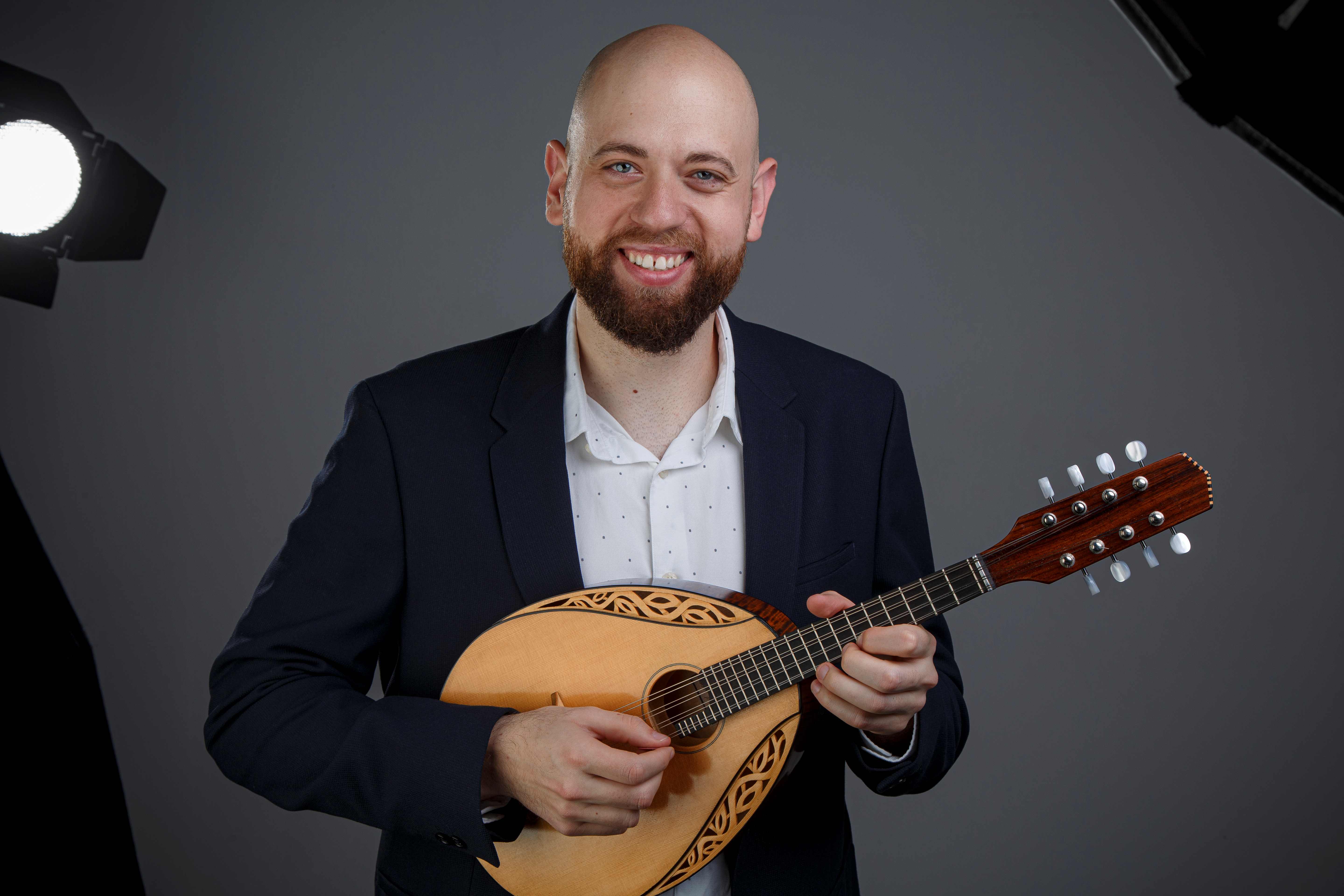
Photo by Michael Pavia
Lina Goncharsky: The ayin will still come in handy, since we want to open people’s eyes to the uniqueness of the Be’er Sheva mandolin school—perhaps we should even capitalize it? Not everyone knows this story, and rightly so: how did an Italian instrument take root and flourish in southern Israel?
Roi Dayan: This extraordinary story began in the 1970s. Imagine: a new immigrant arrives from the Soviet Union, and through the Jewish Agency, he ends up in Be’er Sheva, because that’s where he was assigned to live. His name was Simcha Nathanson. A violinist, he came to the local conservatory, then led by the wonderful pianist Ruth Hilman, and said he wanted to teach violin. She replied, “I already have a violin teacher, but we have a bunch of dusty mandolins in storage. Want to try teaching those?”
Why did she offer this? Two reasons. First, the mandolin’s string tuning is identical to the violin, in fifths. So, mandolins can be tuned exactly like violins—the mandolins we know today, with double strings. The only real difference is the double strings. Second, Nathanson could play Russian folk instruments—balalaika, domra. Ruth decided to experiment, a sort of pilot project. And since Simcha didn’t know mandolin technique, he simply started teaching the children of Be’er Sheva to play the mandolin as if it were a violin, just using a pick instead of a bow. They played violin repertoire: Carl Flesch, Kreutzer, Gaviniès… He transplanted violin pedagogy to the mandolin. That’s how it all began. He also formed a mandolin orchestra in Be’er Sheva, which still exists today.
When Simcha Nathanson retired in 1992, my teacher took over—a man very dear to me. Sadly, many mandolinists today have forgotten his name, but his contribution to the Be’er Sheva mandolin school is no less significant than Nathanson’s. His name was Lev Khaimovich, an immigrant from Vilnius. He wasn’t a mandolinist, but a four-string domra player. The domra comes in two types: three-stringed—tuned like the top three strings of a guitar, and four-stringed—tuned in fifths, like a mandolin or violin. He played the four-stringed version, so switching to mandolin was much easier.
L.G.: Was he also invited to teach mandolin?
R.D.: Yes, there was a competition at the Be’er Sheva Music Conservatory, he entered, and became the next teacher after Nathanson. These two men—Nathanson, who established unconventional mandolin pedagogy, and Khaimovich, who continued it—founded an entire school of Israeli mandolinists now performing worldwide. You can say without exaggeration that Be’er Sheva is one of the three global capitals of the mandolin. The first, naturally, is Italy; the second, Germany. Today, the world’s best mandolinists are Israelis—Be’er Shevans: Shmuel Elbaz, a renowned soloist and conductor; Yaki Reuven, my teacher at the Jerusalem Academy, now living in Spain; Tom Cohen, founder of the East–West Orchestra; Avi Avital, Grammy-nominated, first mandolinist signed by Deutsche Grammophon; and Alon Sariel, specializing in early music.
L.G.: But today, you’re our hero.
R.D.: Well, yes, yes. Hello everyone, my name is Roi Dayan. I was born in Be’er Sheva in 1997, in a regular Israeli family—both my parents were also born here. My mother is a high school teacher, my father works in construction. I began learning mandolin at eight years old at the Be’er Sheva Music Conservatory.
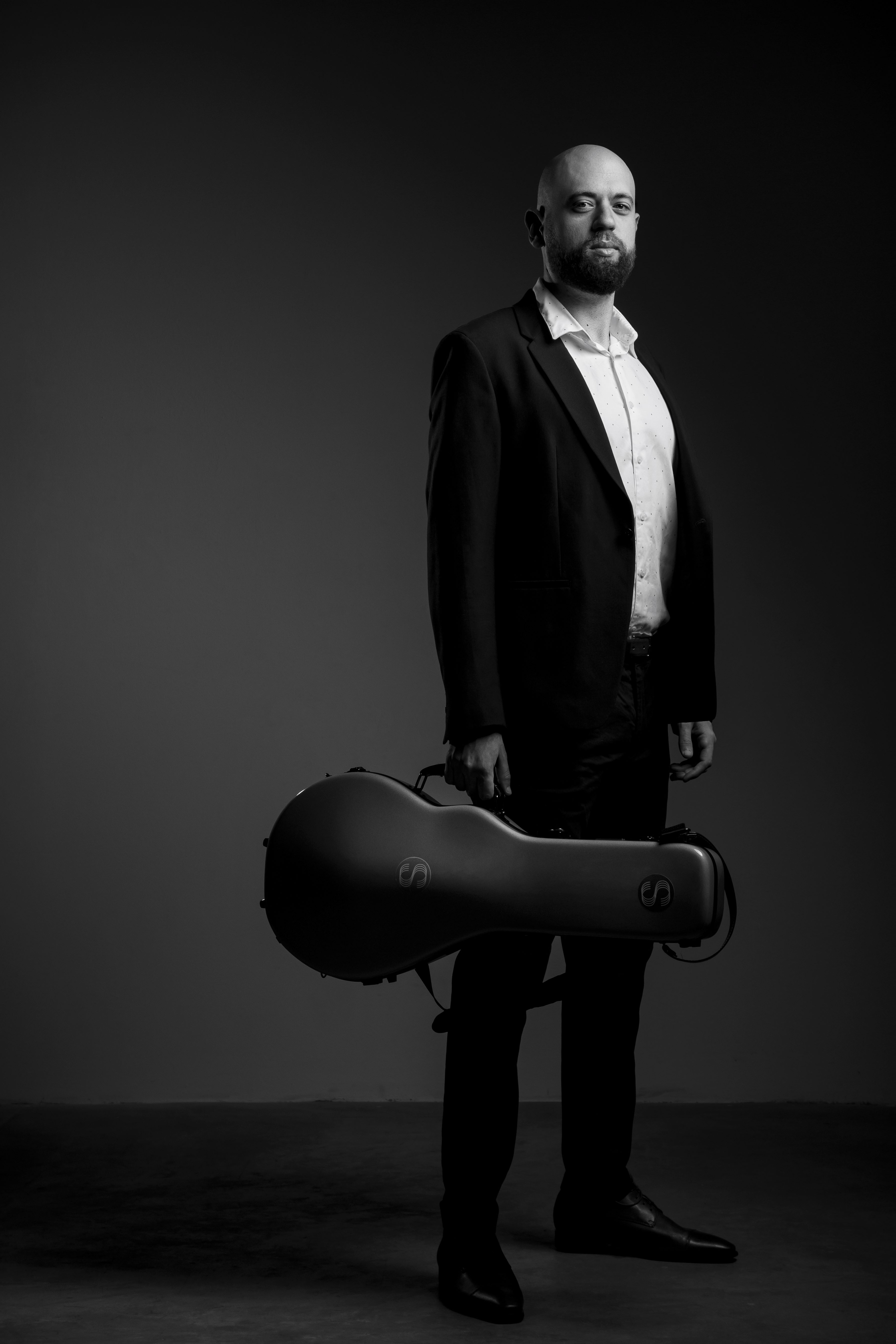
Photo by Michael Pavia
L.G.: Why the mandolin?
R.D.: Honestly, I was at that age when all my friends were picking after-school activities: one chose basketball, another soccer, someone the saxophone, guitar, clarinet… I had a close friend who played mandolin, so I just followed in his footsteps. Pure coincidence. I think one reason I stuck with it professionally is the story behind it. I was Lev’s student—probably his most difficult student. I caused chaos in the orchestra, got kicked out of rehearsals, did countless foolish things. At fifteen, Lev even wanted to expel me, and the conservatory director agreed with him.
L.G.: What did you do?
R.D.: I was a real rebel. Everyone else was doing “X”—I did “Y.” I was late for rehearsals, chatted, misbehaved, sometimes even forgot my mandolin at home… Basically, I was a problematic teenager—scattered, unsure of what I wanted. When I turned fourteen, Yaki Reuven became director of the conservatory. He opened a program for gifted children. I joined because my friends joined. Yaki made me fall in love with the mandolin and turn it into my profession. Thanks to him, I won the America–Israel Foundation competition, the Paul Ben-Haim competition, got into the Jerusalem Academy, and even served in the army without interrupting my studies.
Academy life was the best years of my life: first love, concerts, amazing people. Everything that hadn’t worked out in my teen years suddenly fell into place. Life seemed to open in several directions at once.
I planned to study abroad, but the pandemic intervened. Corona, quarantines, isolation, constant uncertainty—all of it made me reconsider where the world was heading. I decided to stay in Israel and enrolled in a master’s program in contemporary music in Jerusalem. The project is supervised by the Meitar Ensemble, for whom 21st-century music is a natural habitat. I also won an academic concert competition performing Avner Dorman’s Mandolin Concerto, which opened my eyes to contemporary music. Six years later, in 2022, I finished both my bachelor’s and master’s degrees—and hit a crossroads. You know that feeling: you finish school, and the next step isn’t clear. Not everyone immediately finds their way out of that corridor.
L.G.: Ah yes, the existential choice. It reminds me of the Russian painter Vasnetsov’s Knight at the Crossroads, which modern interpretations humorously read as a symbol of human navigation in an information-saturated world—instead of a stone with an inscription, there are social expectations…
R.D.: Exactly, at the crossroads. Then I heard about the ARTE International Mandolin Competition in Tokyo, held once every four years—almost like the Olympics, comparable in scale to a world championship. I hesitated for a long time but finally decided to enter. The first round was a video submission online—I remember it was four in the morning Japanese time, so extremely late for us. But I played in complete silence — everyone was asleep. A week later, I checked Facebook and saw that someone from Israel had passed to the second round. And then I realized it was me.
At the same time, I had no idea how I would play in the second round. The irony was that when applying, you had to list repertoire for future rounds. I chose extremely difficult pieces, far beyond my preparation—because I thought, “No chance I’ll pass.” I decided to go all in. Meanwhile, the Israeli Embassy in Japan and the Jerusalem Academy of Music covered my flight and accommodation— nd I went to Tokyo to play the semifinals and, if lucky, the finals. Twenty performers competed in the semifinal. By lottery, I played last. I remember the tension, the fear. I practiced a lot, but still, I was terrified because the players before me demonstrated incredibly high levels. I went on stage, played the required piece and another—Sarasate’s Carmen Fantasy. He, of course, was a violinist and wrote this fantasy for violin with orchestra. I adapted it for mandolin.
L.G.: How so? I understand the identical tuning (G-D-A-E) allows you to play violin notes directly, bowing is replaced by pick technique, and fingerings are similar…
R.D.: Yes, in 99% of cases, I follow the score almost literally. The trick is making the instrument sound organic. I don’t think every violin piece suits the mandolin. Some transcriptions work more as pedagogical or experimental gestures. Brahms’s concerto for mandolin? Interesting, but in a full orchestral context, it might look flashy but questionable. A symphony orchestra would probably invite a violinist rather than a mandolinist.
But Sarasate worked perfectly. Performing the semifinal felt almost mystical. I’m not very religious, but at that moment I felt as if God were embracing me. The hall was electric; I felt my whole being breathing with the music.
After the semifinal, I ranked first. In the final, I played Avner Dorman’s Mandolin concerto, written in 2006 for Avi Avital. That’s what I played in the finals, and I won first place.
L.G.: That is truly remarkable. The ARTE competition in Japan is very prestigious.
R.D.: I was in a state of absolute madness back then. After that, I realized I wanted to be a soloist. Until then, I had been teaching mandolin in Be’er Sheva, had an orchestra, a mandolin studio—life was clear and stable. In summer 2023, I resigned from all positions and enrolled at the Royal Conservatory of Liège in Belgium with Vincent Beer-Demander. I moved there on October 1, 2023, just before the war. Despite the war, and despite being an Israeli in Europe, professionally everything went well: concerts in Italy, Spain, Belgium, invitations, audiences. I felt growth—more time, concentration, inner resonance.
In March 2024, I was in a serious car accident in Lille, injuring my back. Since then, I play concerts on painkillers and am still in rehab. I decided not to return to Belgium until fully recovered. Also, Belgium isn’t exactly friendly to Israel. For a while, I was in deep depression. I was used to traveling, playing concerts, competitions, going on stage—suddenly life became completely different. Concerts were canceled one after another—in France, Macedonia…
L.G.: How did they explain it?
R.D.: Very simply: “We don’t want to provoke our citizens, we don’t want to create tension. We don’t want Israeli music playing here. Let’s postpone it until better times.”
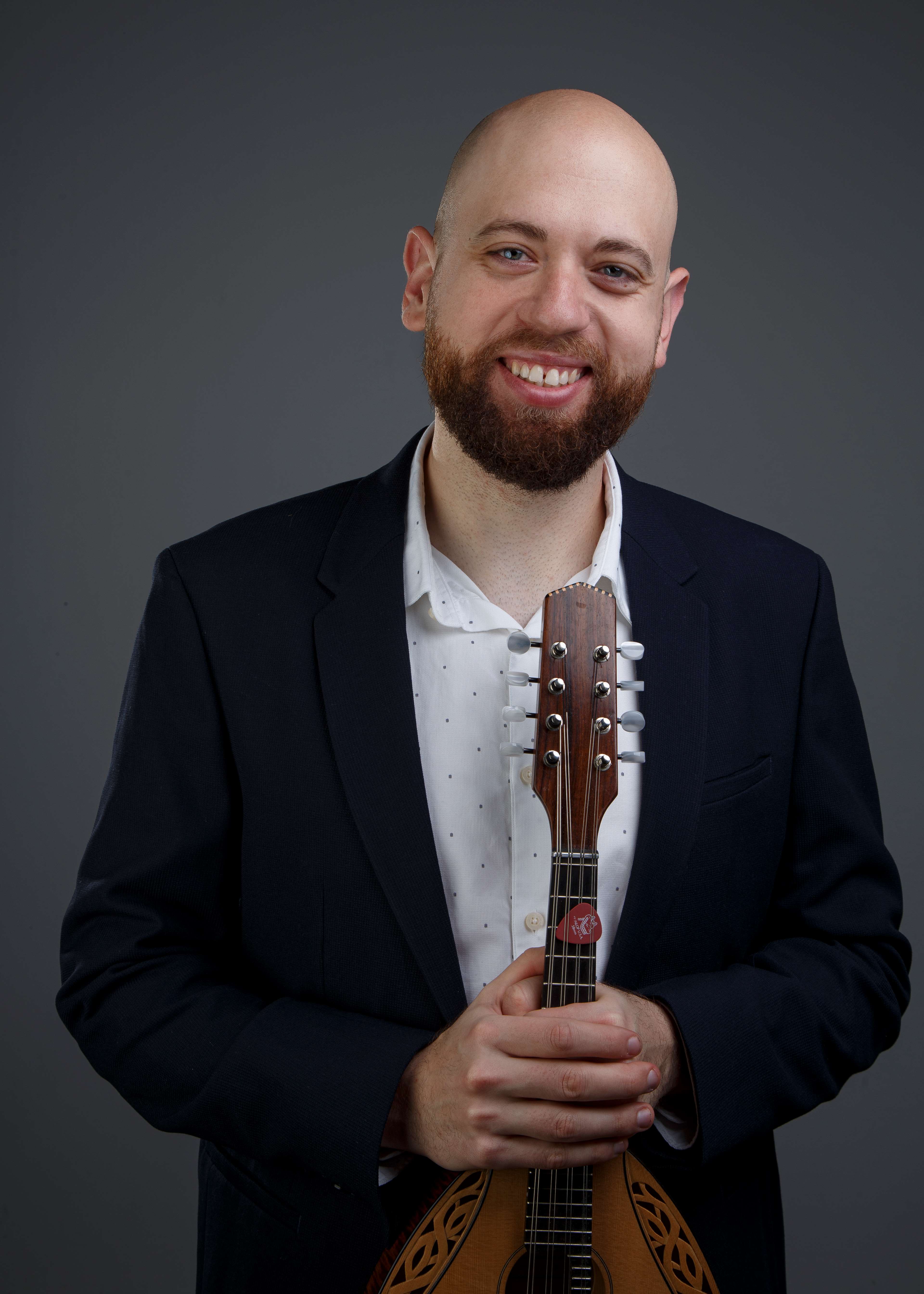
Photo by Michael Pavia
L.G.: But now you’re here, with us.
R.D.: Yes. At the moment, I serve as director of the conservatory of the Eshkol Regional Council, and I live in Kibbutz Nir Am, near Gaza—literally on the very street where Hamas militants broke in on October 7.
The people of Eshkol are extraordinary. Optimistic, strong. They went through hell—there’s no other word for it. And yet the most astonishing thing is that what happened did not destroy them. That is precisely why I accepted this position—because of them.
L.G.: That does sound like a cure for any depression… Tell me, what kind of mandolin do you play? Mandolins must have their own “Stradivarius,” don’t they?
R.D.: Yes, absolutely. The mandolin I play is a very special instrument. Its shape was created specifically for the Be’er Sheva school. It’s not the mandolin people usually imagine visually—the large, rounded, traditional Neapolitan type. Historically, there were many kinds of mandolins—Venetian, Lombard, Cremonese—but in the end, it was the Neapolitan mandolin that “survived.” Tuning in fifths, the classical canon—all of that belongs to it.
We, the representatives of the Be’er Sheva school, play an instrument that is essentially a hybrid of the mandolin and the violin. It was created by a violin maker named Arik Kerman—who, by the way, still lives in Tel Aviv. Originally, he worked exclusively on violins, but he had a great love for folk instruments—domra, balalaika. He observed how the Be’er Shevan school was taking shape and wanted to create an instrument that would meet its needs: above all, the ability to perform the full “violin” repertoire on the mandolin. And he succeeded.
So much so that twenty, thirty, forty years ago, mandolinists around the world used to laugh at it. Today, thousands of luthiers try to build instruments “like Kerman’s.” Among mandolinists, there’s even a term—Kerman-style. If you play a Kerman mandolin, it immediately signals a very high level of artistry. He built outstanding instruments—powerful, serious, with a rich, dense sound. If you play a Kerman mandolin, it immediately signals a high level of artistry. He made outstanding instruments — powerful, serious, rich in sound. Now he’s about eighty-eight and no longer builds instruments; his son carries on. Luckily, I play a mandolin Arik made himself.
L.G.: Once, I was sitting in the front row at a concert by bandoneonista Mario Stefano Pietrodarchi, and it felt as though he was making love to his instrument. Quite literally. How do you relate to your mandolin?
R.D.: I’m someone who genuinely believes that everything comes down to service. As a performer, as an artist, I exist to give the audience an experience, an emotion. I love my instrument, I love playing, because it’s a huge privilege to get up and share music with people. Probably that’s why I play less contemporary music these days—unfortunately, audiences come to it less often. I am very sensitive to my listeners, and I want to give them the music that resonates with them.
Perhaps that’s why today I devote less time to contemporary music: unfortunately, audiences are coming to hear it less and less. And I’m someone who is very finely attuned to the listener. I want to give them the music that truly resonates with them.
L.G.: Do contemporary composers write much for the mandolin?
R.D.: Yes, definitely. And they always have—including Israeli composers, even before the Be’er Sheva school existed. And afterward, even more works for the instrument began to appear. For example, the remarkable composer Gilad Hochman, now living in Germany, wrote an opus called Wanderings, which I perform with the Israel Camerata. He composed it for the outstanding mandolinist Alon Sariel. According to Gilad, he sought to convey the spirit of the desert, the spirit of the land of Israel. His family roots are in the Maghreb and Tunisia, and so he tried to merge the Western musical tradition he studied with the desert breath of the Negev—its landscape and the atmosphere of the East.
Our interpretation with the Camerata is very special. It’s an outstanding orchestra, rightly considered among the leading ensembles in the country—because it is guided by people who understand music profoundly: Avner Biron and Boaz Schory, my dear friend. I value and love Boaz greatly; he is a remarkable person who, in my view, is doing an extraordinary job. Boaz has spent many years managing cultural institutions and held a senior position at Sal Tarbut—that’s where we first met—and today he serves as CEO of the Israel Camerata. The orchestra is in very good hands.
L.G.: Imagine if the mandolin could speak, what language would it speak to you in?
R.D.: It depends on the concert. One evening it might speak Italian, another French, or even the Be’er Sheva dialect, if you will. I don’t really divide music into genres. I might dream of performing Gilad Hochman’s works one day, play a concerto by Raffaele Calace the next, then Umm Kulthum, French chanson, Greek music, and a week later—Russian music. I believe that if the music is good, then it’s good. That’s enough.
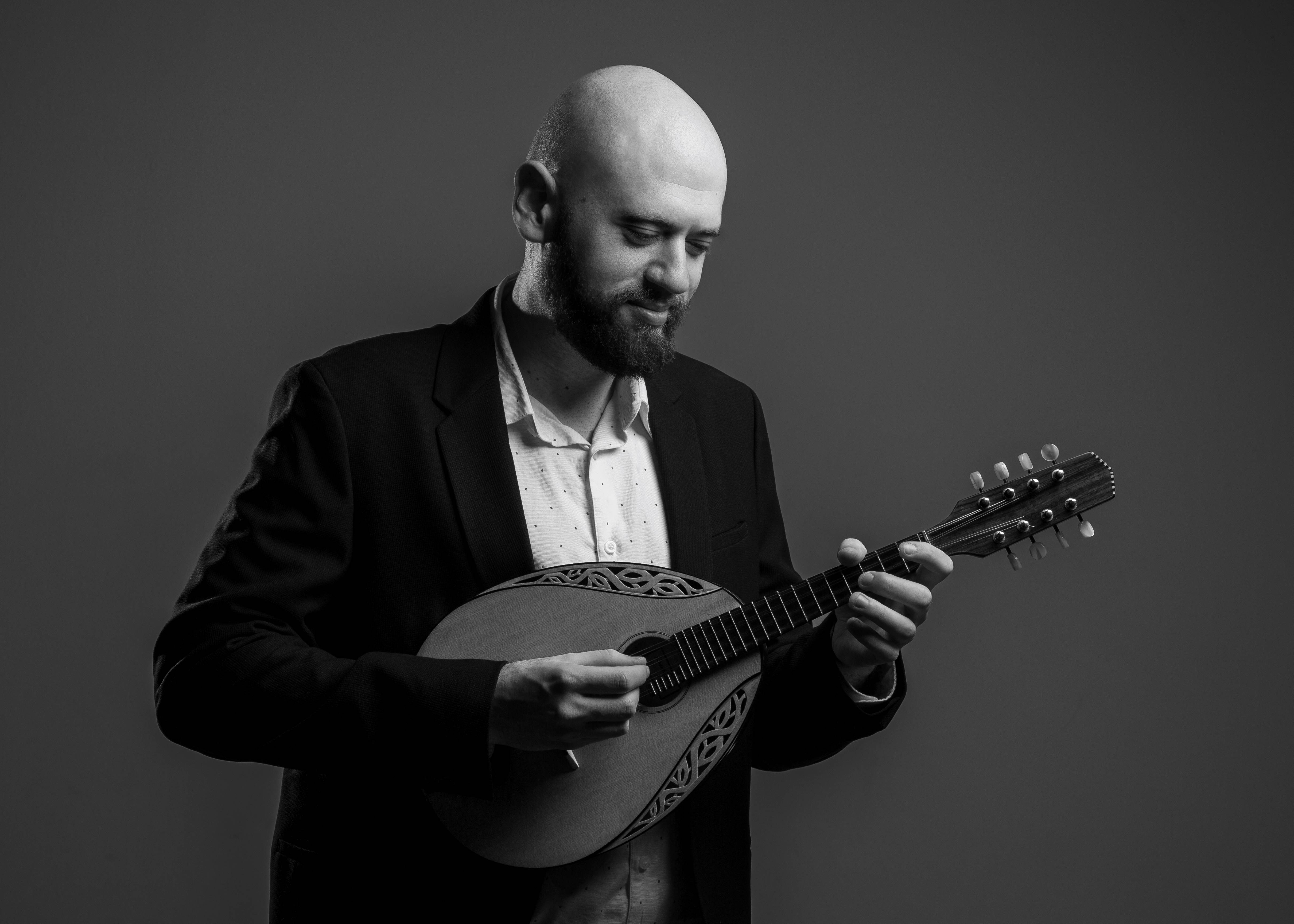
Photo by Michael Pavia
L.G.: Does the mandolin have a memory? Does it remember the fingers and hands that touched it, or is it a fresh start every time?
R.D.: Absolutely it remembers! And the beauty of the mandolin is that it “breathes” in its own way. I have two concert instruments at home, each with its own strengths and weaknesses. I play both—and they sound different. Even if my friends pick up the same mandolin, it will still sound different.
L.G.: And if you play the same mandolin, does it still behave differently?
R.D.: I’ll go even further: in periods when I play a lot, it sounds better—at least, that’s how I feel it. And in periods when I play less, it sounds noticeably worse, as though it’s drifting away from me.
L.G.: Which part of your body do you feel the mandolin with the most strongly while playing?
R.D.: Almost always—the heart. The fingers, of course, do their work, but in the end, everything comes from the heart. That’s why I believe it doesn’t matter how many hours you practice or play; if it’s not in your heart, in your soul, it doesn’t matter. After all, the mandolin is just a piece of wood with metal strings. Without warmth of soul, it won’t come alive.
L.G.: Is there a movement, a gesture, that’s impossible to explain technically, but without which you simply can’t produce sound?
R.D.: I’d say, first and foremost—breathing. I breathe deeply while playing, sometimes unconsciously. These are my instinctive movements, emerging naturally as I play.
L.G. Yes, you can feel it—you literally breathe with the music… Do you think the mandolin feels comfortable in our time?
R.D.: I think so. The mandolin is an instrument of the past, the present, and the future. This may be subjective, but when I come to a concert as a listener, I’m far more interested in hearing a soloist with a bandoneon, a baglama, or a mandolin than a soloist at the piano, or with a clarinet, flute, or violin. It brings new breath, new colors into the familiar classical orchestra. And besides— you know me—I’m a breaker of conventions.
L.G.: Is there a sound that could be called “Be’er Shevan,” Middle Eastern, Israeli—a sound impossible to notate literally but instantly recognizable?
R.D.: Yes, and there are several techniques. The Be’er Sheva school is not just about virtuosity, it’s a fundamentally different way of holding the plectrum. I hold it differently than, say, the Italian Eugenio Palumbo. And precisely because of that, sounds emerge that I would call uniquely Be’er Shevan. In summer 2023, I played in Germany with an ensemble led by Avi Avital, performing a Vivaldi concerto. There’s a technique—a kind of “string hop.” After rehearsal, students came to me asking, “How do you do that?” I told them, “Guys, go to Be’er Sheva—that’s where they teach it.”
L.G.: Are there other mandolin schools in the world that you value?
R.D.: Italian school, of course—it’s the original source, which then spread across Asia: Taiwan, China, Japan—where it took deep root. If we’re talking about purity and beauty of tone, however, I think the German school produces the most beautiful sound. But both German and Italian schools are conservative, and like in world politics, both tend to regard the Israeli school rather coolly.
L.G.: Even plectrums differ?
R.D.: Yes, German plectra are quite similar to domra picks—very different shape and held differently. In general, German plectrums lean toward an oval shape. The ones I use are more like guitar picks. But the paradox is that both German and Italian schools don’t particularly appreciate anything outside their framework. The Be’er Sheva school does, and we love it for that.
L.G.: It seemed to me, or do you really improvise during concerts?
R.D.: Very often. Parts of Gilad Hochman’s Wanderings, for example, are built on improvisation, on fragments of freedom. You’ll hear it in my performance; much of it is born here and now.
L.G.: That already sounds a bit like jazz.
R.D.: Exactly. That’s why I don’t belong to a single school. I’m open to genres—jazz, Eastern music, Andalusian traditions, country, rock. I play everything I love.
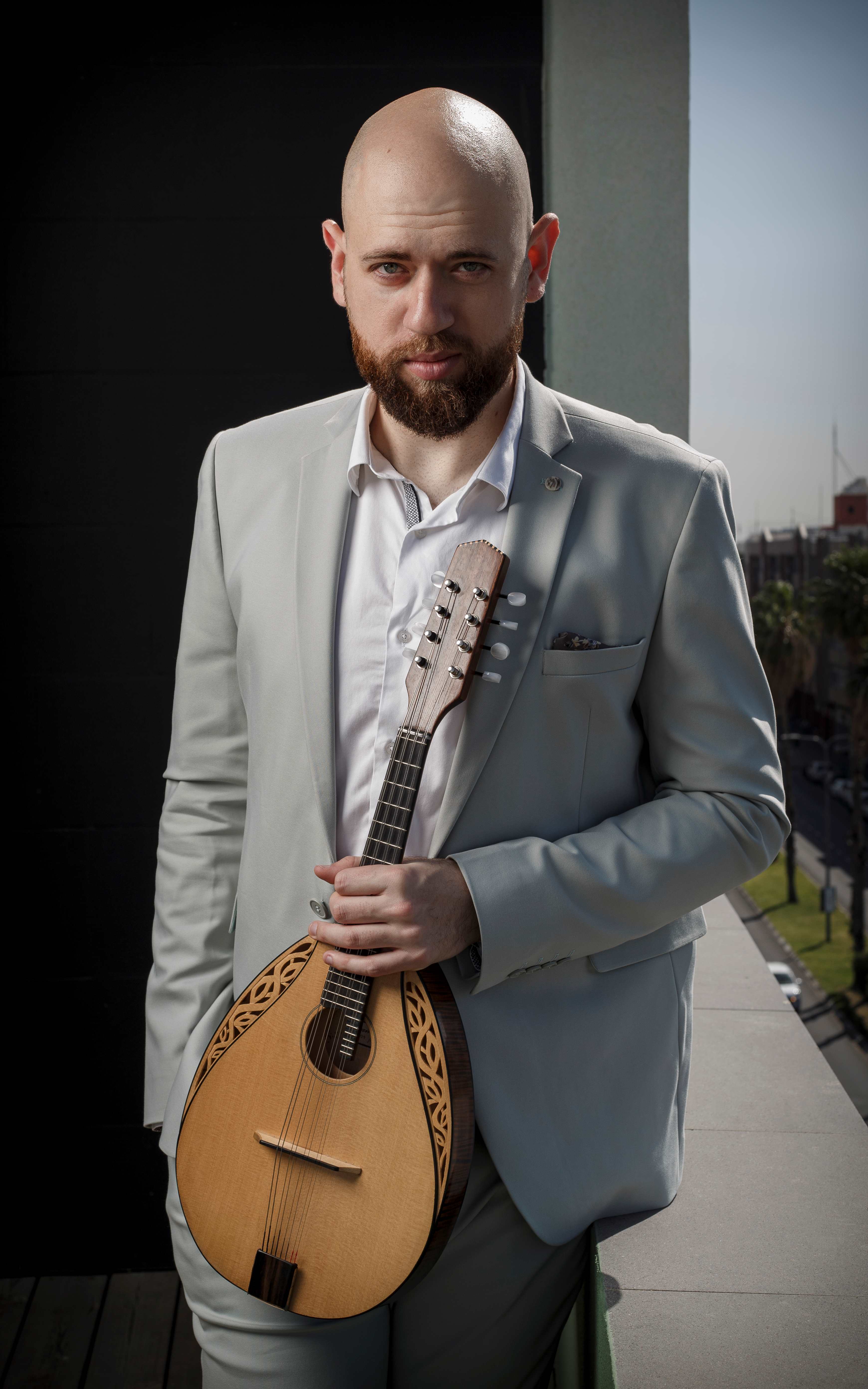
Photo by Michael Pavia
L.G.: If you could ask your mandolin just one question—what would it be?
R.D. I’d ask whether it thinks I play well. (laughs)
L.G.: And seriously?
R.D.: Then I’d ask if it feels that I treat it with proper respect. Honestly, I’m not sure who I’d be today or how my life would have unfolded without it.
L.G.: And if—God forbid—the mandolin disappeared, what would we lose?
R.D.: Honestly, I’ve never really thought about that. Rather… hmm. Let me put it this way: this instrument constantly gives us something new, unexpected, alive. If we lose it, we lose a source of renewal. One problem with classical music today is too much conservatism, too many rigid perspectives. Everything moves down the same narrow corridor. If we continue like this, we’ll lose the audience.
Here’s a simple example. There’s one thing I no longer do. I used to—now I don’t. My concerts, when I play as a soloist with orchestra, harpsichord, or continuo, now last no more than an hour. Because I believe a concert today should not exceed sixty minutes. First, to leave the audience wanting more. Second, to avoid tiring them. After all, we want to keep the listener engaged—so they leave thinking, “Wow, that was amazing, I want to hear it again.” Our task is to move the listener. From this perspective, if we lose the mandolin, we lose yet another opportunity to bring music back to life.
Roi Dayan’s concerts with the Israel Camerata Jerusalem will take place from February 25 to 27 in Zikhron Ya’akov, Jerusalem, and Tel Aviv. Tickets available here. Promo code: 10 |







;void(0);)
;void(0);)
;void(0);)
;void(0);)
;void(0);)


